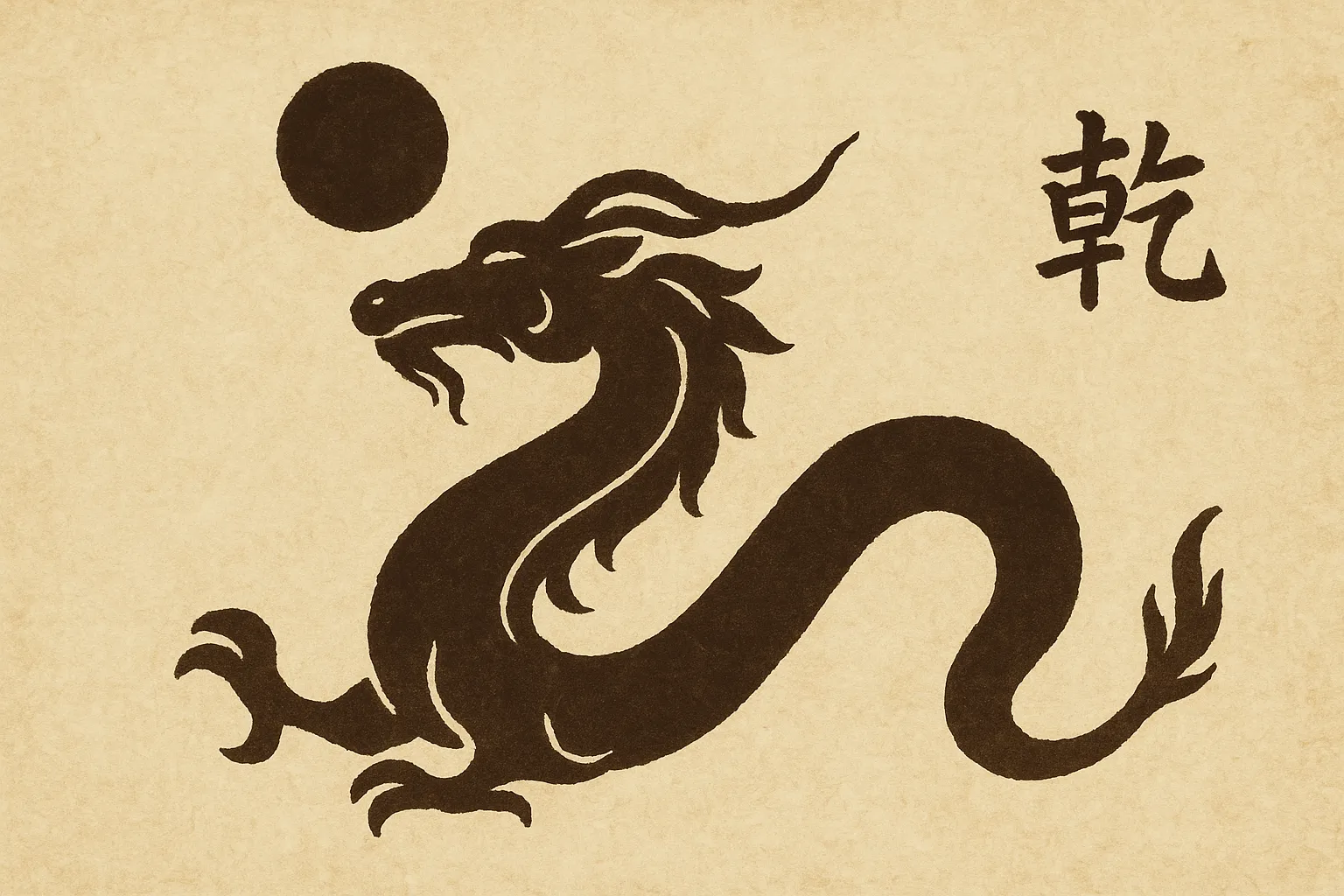
Potential — Void or the Tao
Unmanifest potential precedes Yin and Yang.
At the heart of I Ching cosmology, before any manifestation, lies the concept of Wú Jí (無極), the Supreme Void or Boundless Potential. This is the primordial state of non-differentiation, where all things exist in a latent state, without form or distinction. Wú Jí is often associated with the Tao (道), the Way or the Universal Principle that governs existence. It is not a void of absence, but a void of fullness — containing the seed of everything that is to be.
This state of pure potential is the source of all creation. It is the silence before sound, the darkness before light, the unity before duality. In the I Ching, the first line of a hexagram — representing the beginning — can be seen as the emergence of potential from Wú Jí. It is the foundation on which all the complexity of the universe is built.
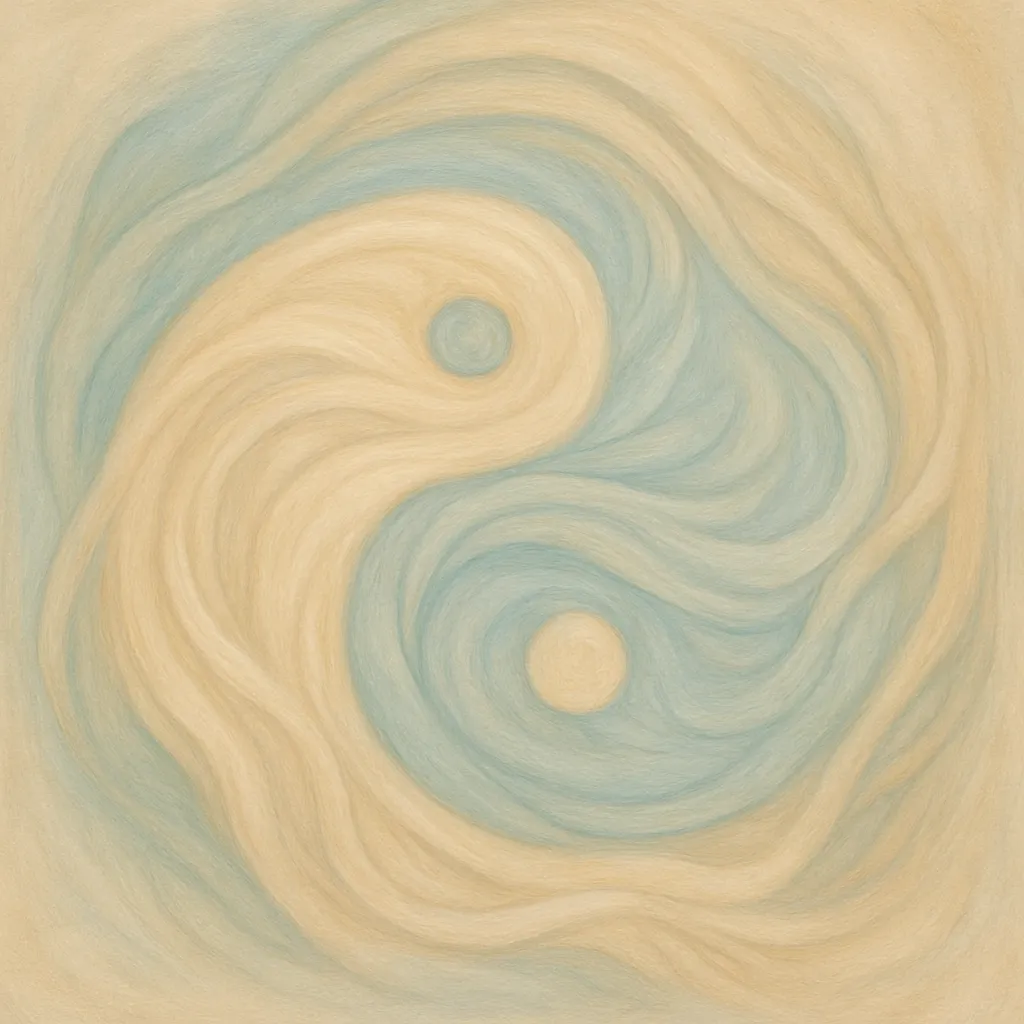
Birth — Yin/Yang in unity
Primordial unity presents itself as complementary pairs not yet in opposition.
From Wú Jí, the boundless potential, emerges Tài Jí (太極), the Great Beginning or Supreme Ultimate. Tài Jí represents the first differentiation of the Tao, where Yin and Yang are born as a primordial unity — not yet in opposition, but as complementary and inseparable aspects of a whole. It is the moment when duality begins to manifest, in an integrated and harmonious form.
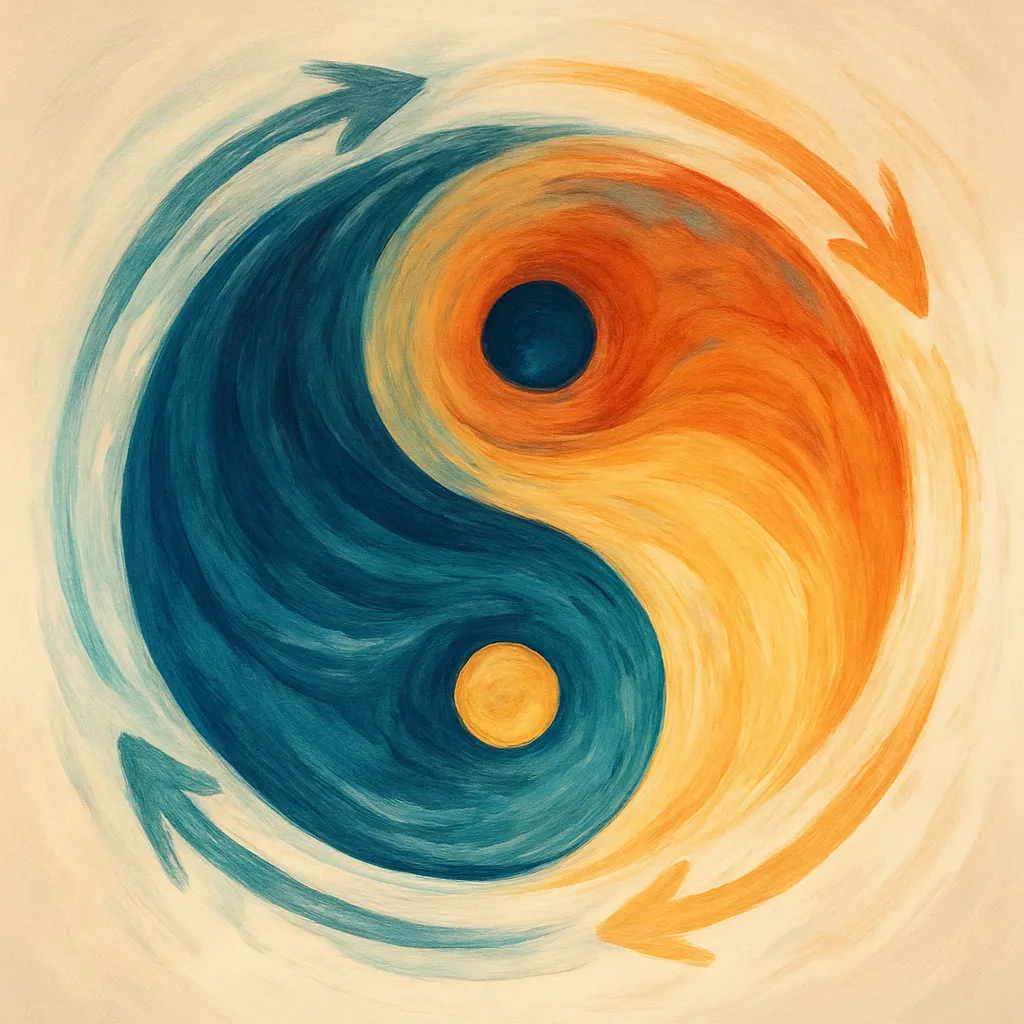
At this stage, Yin and Yang are not conflicting forces, but polarities that contain one another, like the two halves of a perfect circle. They are interdependent and coexist in balance, symbolizing the continuous flow of life and energy. The image of Tài Jí, with its smooth curves and the presence of the opposite point in each half, perfectly illustrates this unity within duality.
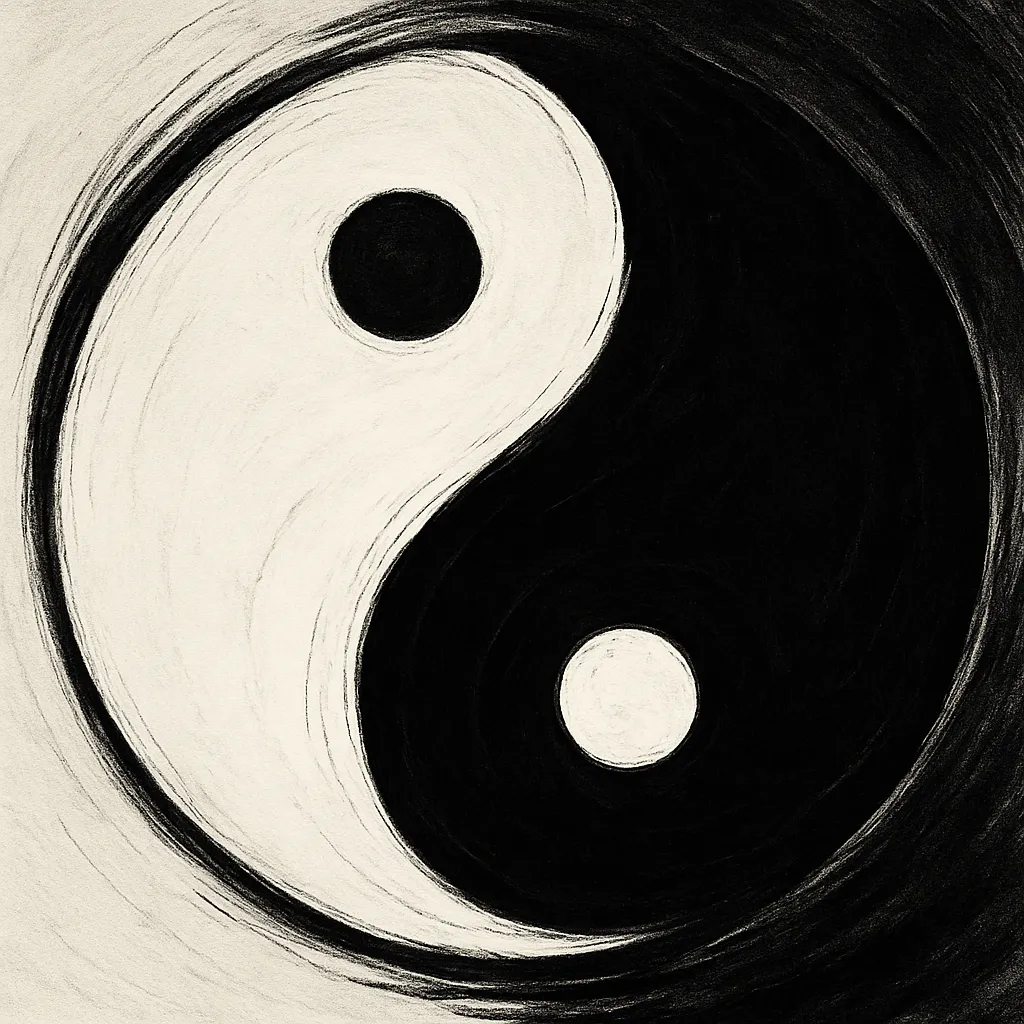
Duality — Yin and Yang in opposition
Polarity inaugurates cycles, creative tensions and the dance of opposites.
After birth in unity, Yin and Yang manifest in their full duality, becoming opposing yet intrinsically connected forces. This is the stage where polarity becomes evident, creating the dynamic essential to existence and change. Yin (feminine, receptive, dark, passive) and Yang (masculine, active, bright, creative) interact constantly, generating every phenomenon in the universe.
The opposition between Yin and Yang is not one of destructive conflict, but of complementarity and interdependence. Neither can exist without the other, and the interaction between them is what drives life and transformation. This dance of opposites is the foundation for understanding natural cycles — day and night, summer and winter — and the processes of growth and decline.
Transformation — Yin ⇄ Yang
Continuous mutability: each pole contains the seed of the other, generating change.
The cosmology of the I Ching is fundamentally about change. The transformation between Yin and Yang is a continuous and dynamic process, where each pole, upon reaching its extreme, turns into its opposite. This is symbolized by the small circle of opposite color within each half of the Tài Jí symbol, indicating that within Yin there is the seed of Yang, and within Yang, the seed of Yin.
This mutability is the essence of the universe and of life. Nothing is static; everything is in constant flow and evolution. Transformation is not annihilation, but a transition — a rebirth. The I Ching, as the Book of Changes, offers a guide for understanding and navigating these changes, showing how situations develop and transform from one state to another.
Trigrams — Heaven, Earth and Humanity → 8 trigrams
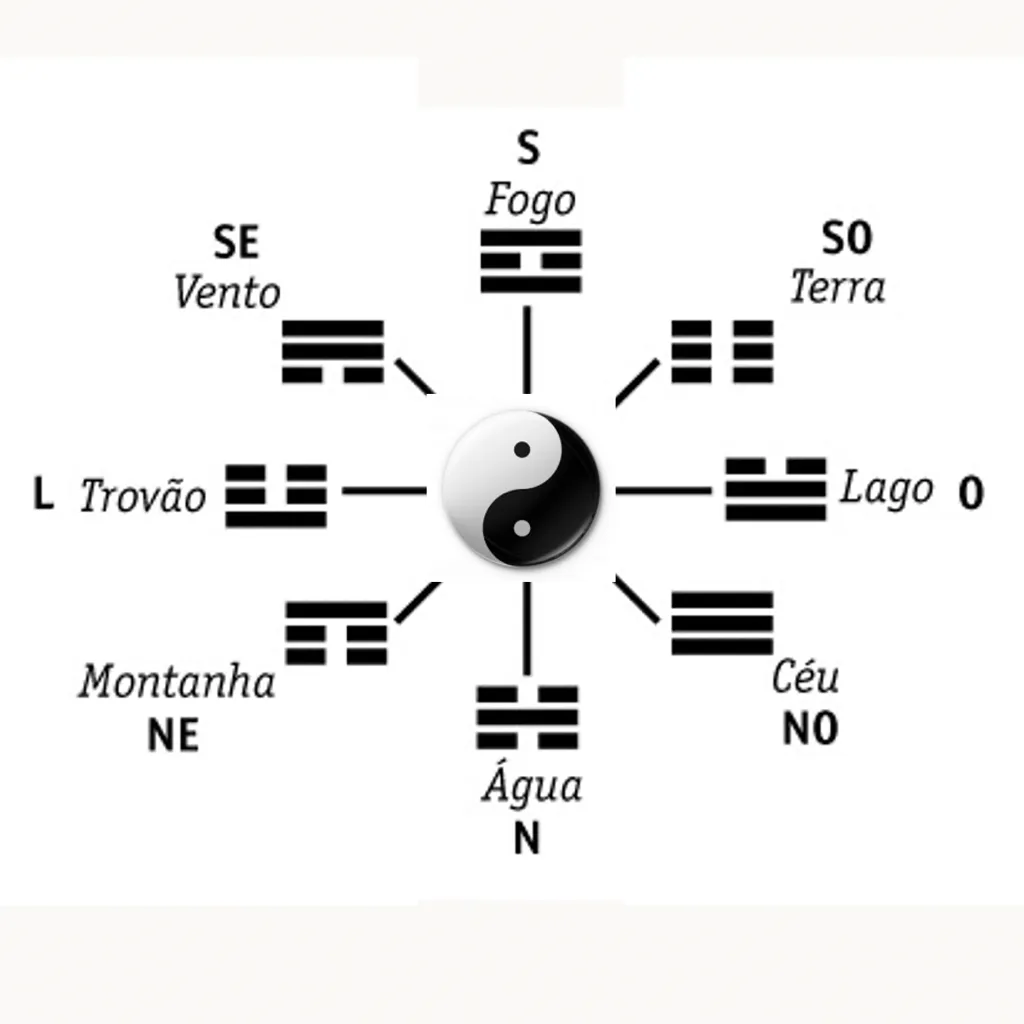
From the three powers emerge eight basic patterns (☰ ☱ ☲ ☳ ☴ ☵ ☶ ☷).
From the interaction of Yin and Yang arise the Trigrams (Bā Guà), the eight possible combinations of three lines (Yin or Yang). Each trigram represents a fundamental force of nature and an aspect of existence, reflecting the interplay between Heaven (Yang), Earth (Yin), and Humanity (the middle line).
- ☰ Qián (Heaven): The Creative, strength, father.
- ☱ Duì (Lake/Mist): The Joy, satisfaction, youngest daughter.
- ☲ Lí (Fire): The Adhering, clarity, middle daughter.
- ☳ Zhèn (Thunder): The Inciting, movement, eldest son.
- ☴ Xùn (Wind/Wood): The Gentle, penetration, eldest daughter.
- ☵ Kǎn (Water): The Abysmal, danger, middle son.
- ☶ Gèn (Mountain): The Stillness, repose, youngest son.
- ☷ Kūn (Earth): The Receptive, devotion, mother.
Use the controls to the side to explore each trigram individually. Click the thumbnails or use the arrows to navigate. Keyboard shortcuts: numbers 1-8 for direct access, Back to Bā Guà to return to the overview.
Hexagrams — Combination of the 8 trigrams
64 combinations (lower + upper trigram) describe situations and counsel.
The culmination of I Ching cosmology manifests in the Hexagrams. Each hexagram is composed of six lines, resulting from the combination of two trigrams: a lower trigram (representing the inner situation or base) and an upper trigram (representing the outer situation or influence). With eight possible trigrams for each position, there are 8 × 8 = 64 unique hexagrams.
Each of the 64 hexagrams symbolizes an archetypal life situation, a state of change, or a specific piece of counsel. Use the controls below to explore different combinations. The active mode is highlighted in purple — click the label to toggle between Upper and Lower.